






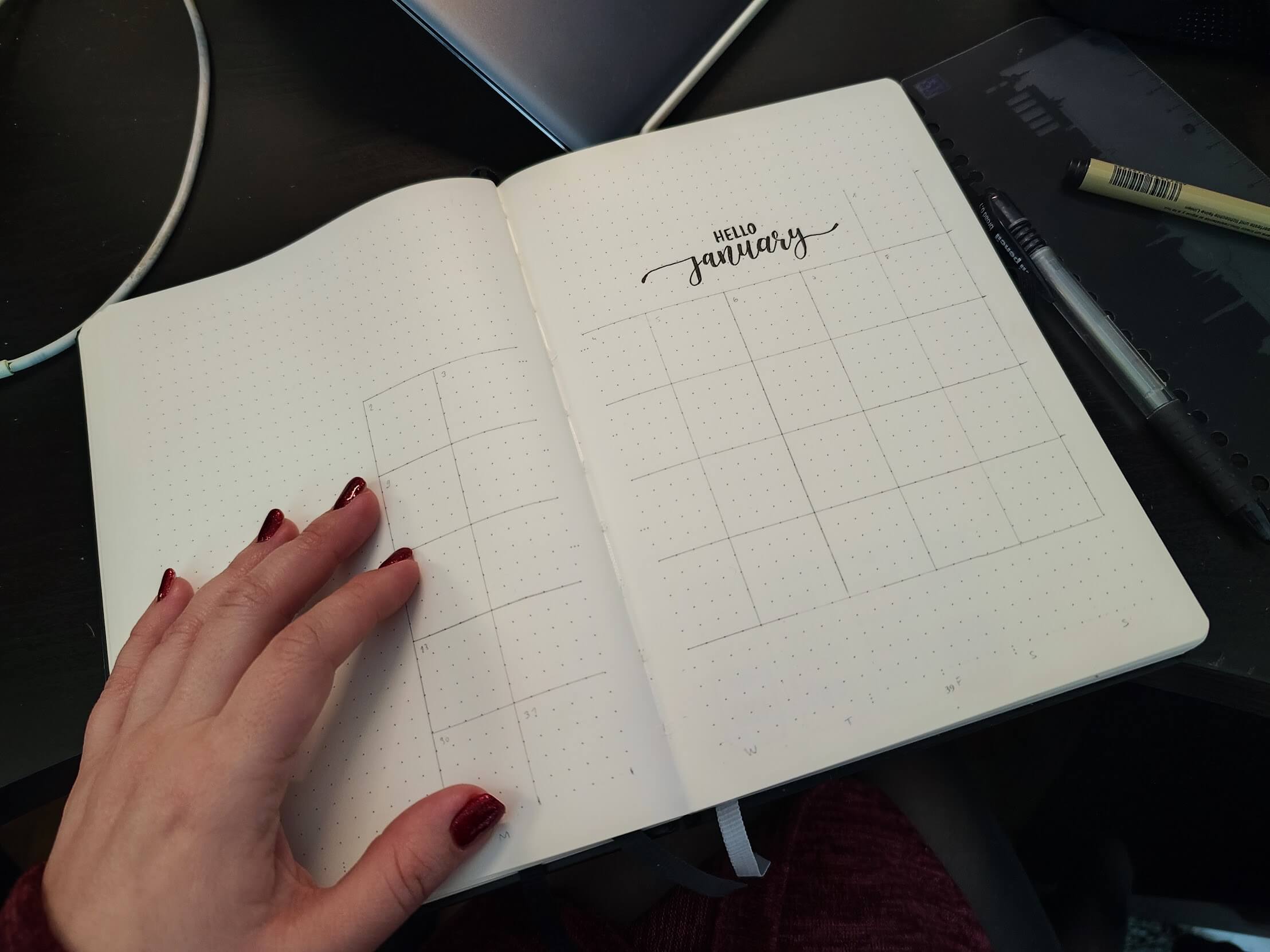
This is a starting layout, not a template you must follow exactly. The Bullet Journal method’s core pages are the index, future log, monthly log, and daily log. You need a notebook and pen; ruled, dotted, and blank pages can all work. For the symbols and review routine, see our guide to the Bullet Journal method.
Pages 1–2: index
Write “Index” across the top of the first two pages. Leave them mostly blank. When you create a section, note its name and page number here: “Future log — 3–4,” “November — 5–6,” or “Job applications — 9.” Number each page as you use it. You do not have to predict every section in advance, and a collection can start wherever the next empty page happens to be.
Pages 3–4: future log
Divide two facing pages into six labeled spaces for the coming months, or use more pages if you need them. Put events and tasks here when they belong beyond the current month. For example, “January — renew passport” or “February 12 — conference.” Keep entries short. When that month arrives, copy relevant items into its monthly log. The official introduction describes the future log as the place for commitments ahead.
If your notebook starts in the middle of a year, begin with the next month; there is no need to backfill empty calendar pages. Add the future log’s page numbers to the index.
Pages 5–6: monthly log
Use the left page for a simple calendar: write the month at the top, then list dates down the page. Add brief events beside the relevant dates. Use the right page for tasks you may work on during the month. The creator’s monthly-log instructions use this calendar-and-task-page arrangement.
For example, the calendar might say “12 — dentist, 2 p.m.” while the task page says “• Book rail tickets.” Put a task next to a date only if that date actually matters. A monthly log is an overview, so a long project plan can have its own collection instead.
Next available page: daily log
Write today’s date, then capture what you need to do or remember. The basic symbols are • for a task, O for an event, and – for a note. You might write “• Send invoice,” “O Team call, 10 a.m.,” and “– Ask whether the deadline changed.” Mark a finished task X. You can continue tomorrow immediately below today’s entries; there is no need to reserve a full page per day. The official daily-log guide uses this open-ended approach.
At the end of the day, look at open tasks. Some will be done tomorrow, some belong later, and some can be crossed out. At the start of the next month, review open tasks again and move only the relevant ones into the new monthly log or future log. This is called migration.
Later pages: collections when you need them
A collection is a page for one topic: a project, reading list, travel plan, or meeting notes. Give it a title, use the next free page, and add that page number to the index. If it fills up, continue on another page and list both locations in the index. You can keep a weekly spread, habit tracker, or decorated cover page if it helps you; none is required to begin.
A one-page setup check
- Page numbers are visible and the index is easy to update.
- Future commitments have a place outside the current month.
- The monthly log separates dated events from the month’s task list.
- The daily log has enough space for today’s actual entries.
- At review time, you know where each unfinished task should go.
If the first layout feels cramped, change the next one. A bullet journal uses the space you need rather than forcing every week or day into the same fixed template.
Frequently asked questions
What goes on the first page of a bullet journal?
Reserve the first page or two for an index. Add section names and page numbers as you make new logs and collections.
How many pages should I leave for the future log?
Two facing pages are a common starting point for six upcoming months. Use more or fewer pages to match the number of commitments you record.
What is the difference between a monthly log and a daily log?
The monthly log holds an overview of dates and tasks for the month. The daily log captures today’s tasks, events, and notes in the next available space.
Do I need to set up every month in advance?
No. Make the next monthly log when you reach it. You cannot know in advance how many daily pages or collections you will use.
Where should a project plan go?
Give it a collection on the next free page, then record its title and page number in the index. Keep only the relevant next actions in your monthly or daily log.
Can I start a bullet journal in the middle of a notebook?
Yes. Number the remaining pages, reserve a little space for an index, and start with the current month and today’s date. You do not need to copy earlier months.

Lorelei has been an online entrepreneur, marketer and writer since 2006. Her biggest passion is WordPress, which is why she switched to being a full-time blogger 20 years ago and hasn’t looked back since. With so many years of experience behind her, she is an expert in copywriting, SEO, marketing and business strategies.

